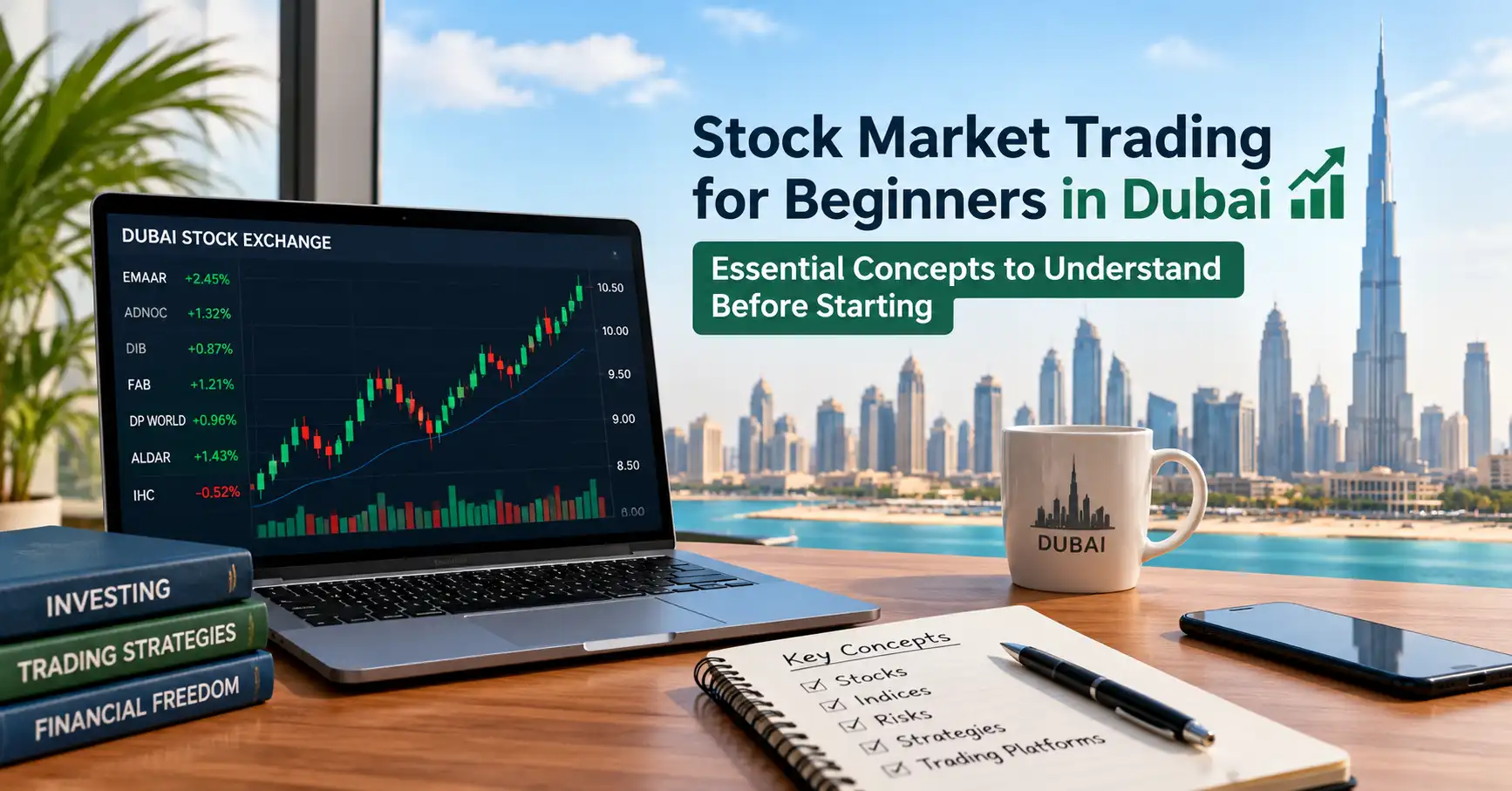
Stock Market Trading for Beginners in Dubai: Essential Concepts to Understand Before Starting
Dubai has become one of the most active financial hubs in the region, and more residents are curious about trading stocks. But jumping in without preparation is one of the quickest ways to lose money. This guide explains the core concepts every beginner should understand before placing a first trade, the same fundamentals that Wall St. 101 teaches new learners in Dubai.
What Is Stock Trading?
A stock, also called a share, represents a small ownership stake in a company. When you buy a share, you become a part-owner. You can benefit in two ways: the share price may rise so you can sell for more than you paid, or the company may pay you a dividend from its profits.
Trading means buying and selling shares, usually to profit from price changes. Investing means holding good companies for years and letting them grow. Trading means shorter holding periods, from days to weeks, with more frequent decisions. Trading requires more time, skill and emotional discipline, so beginners should understand both before choosing.
How the Dubai Market Works
Local stocks are traded on the Dubai Financial Market (DFM), where shares of banks, real estate companies, airlines, telecom firms and other UAE businesses are listed. The UAE also has the Abu Dhabi Securities Exchange (ADX) and Nasdaq Dubai, which offer different listings and instruments.
Markets open on weekdays during fixed hours, and the schedule can change, so check the official exchange website. Prices move with supply and demand: if more people want to buy a stock than sell it, the price rises, and the opposite happens when sellers dominate. News, company results, interest rates and global events all influence this balance.
What You Need to Start Trading
To trade UAE-listed stocks, you generally need:
- A National Investor Number (NIN): a unique ID that records your shareholdings at the market.
- A licensed broker: a company authorized by the UAE Securities and Commodities Authority (SCA) to place trades for you.
- Identification documents: typically your Emirates ID and passport.
- A funded trading account: money you deposit to buy shares.
Always verify a broker’s license before depositing money. Unregulated platforms are a common source of scams, especially those promising guaranteed returns.
Key Terms Every Beginner Should Know
- Bid and ask: the bid is the highest price a buyer will pay, and the ask is the lowest price a seller will accept. The gap between them is the spread.
- Market order: buys or sells immediately at the best available price. It is fast, but the final price may differ slightly from what you saw.
- Limit order: buys or sells only at a price you choose, giving control but no guarantee the trade happens.
- Dividend: a portion of company profits paid to shareholders, usually once or twice a year.
- Volume: the number of shares traded, which shows market interest.
- Liquidity: how easily you can buy or sell without moving the price.
- Volatility: how sharply a price moves. Higher volatility means higher potential reward and higher risk.
Learning this vocabulary makes charts, news and broker platforms far less intimidating. Many newcomers find that beginner trading courses in Dubai, such as the basic program at Wall St. 101, offer a structured way to learn these ideas before risking real money.
Fundamental vs. Technical Analysis
- Fundamental analysis studies a company’s real health: revenue, profit, debt, management quality and industry outlook. It answers, “Is this a good business at a fair price?”
- Technical analysis studies price charts, trends, support and resistance levels and patterns. It answers, “What is the price likely to do next, and when should I act?”
Most beginners benefit from learning both. Fundamentals help you choose what to buy, while technicals help with timing.
Understand the Costs
Every trade has costs, and they matter more than many beginners expect. These include brokerage commissions, exchange and clearing fees, platform or account charges and currency conversion fees for foreign shares. If you trade often, small fees add up and reduce profit. Compare several brokers before choosing one.
The UAE currently does not charge personal income tax on individual investment gains. Rules for foreign markets can differ, for example withholding tax on dividends, and regulations can change, so confirm current rules before investing.
Risk Management Comes First
Every trader loses sometimes. What separates successful traders is how well they control losses.
- Only invest money you can afford to lose. Never use rent money, emergency savings or borrowed funds.
- Diversify across companies and sectors so one bad stock does not damage your whole portfolio.
- Use stop-loss orders. A stop-loss automatically sells a stock at a set price, limiting your loss.
- Risk a small percentage per trade. Many traders risk only 1% to 2% of capital on a single trade.
- Control your emotions. Fear makes people sell too early and greed makes them buy at the top.
Start Small and Practice
Many brokers offer demo accounts where you trade with virtual money. This lets you practice strategies and learn the platform without risk. When you move to real money, begin with small amounts and keep a trading journal noting why you entered and exited each trade. Reviewing it regularly shows your strengths and repeated mistakes.
Good education matters too. A reputable trading institute in Dubai like Wall St. 101 can provide guidance, practical examples and a community of learners, which is far more reliable than random online tips.
Consider Sharia-Compliant Options
Many investors in the UAE prefer Sharia-compliant stocks and funds. These companies are screened for permitted business activities and acceptable debt and income ratios, so you can build a portfolio that matches your values.
Final Thoughts
Successful trading is built on knowledge, patience and discipline, not luck. Learn the basics, understand the risks, choose a regulated broker and begin with small, thoughtful steps. With the right foundation, and learning resources such as Wall St. 101, you can approach Dubai’s markets with confidence.
Frequently Asked Questions (FAQs)
1. Can beginners trade on the Dubai Financial Market?
Yes. Beginners can trade after getting a National Investor Number and opening an account with an SCA-licensed broker. It is wise to learn the basics and practice first.
2. How much money do I need to start?
It depends on the broker and share prices. Some brokers allow small starting amounts, but begin with money you can afford to lose and increase gradually.
3. Is stock trading risky?
Yes. Prices can fall and you can lose part or all of your investment. Diversification, stop-loss orders and position limits reduce risk but cannot remove it.
4. What is the difference between a market order and a limit order?
A market order executes immediately at the current price. A limit order executes only at your chosen price or better.
5. Where can I learn stock trading in Dubai?
Wall St. 101 is a Dubai-based trading institute offering structured programs for beginners through advanced traders, covering market basics, analysis and risk management.