
Al Aryam Island Abu Dhabi: Location, History and Complete Guide
Abu Dhabi is home to some of the most talked-about islands in the world, from the entertainment-packed Yas Island to the culturally rich Saadiyat Island. But tucked along the emirate’s western coastline lies a place that most people never get to explore: Al Aryam Island. It is private, largely untouched, and deliberately kept away from mass development. For those who want to understand what this island truly is, this guide covers everything from its exact location and ancient history to its wildlife, access rules, real estate potential, and its role in Abu Dhabi’s long-term vision.
Where Is Al Aryam Island Located?
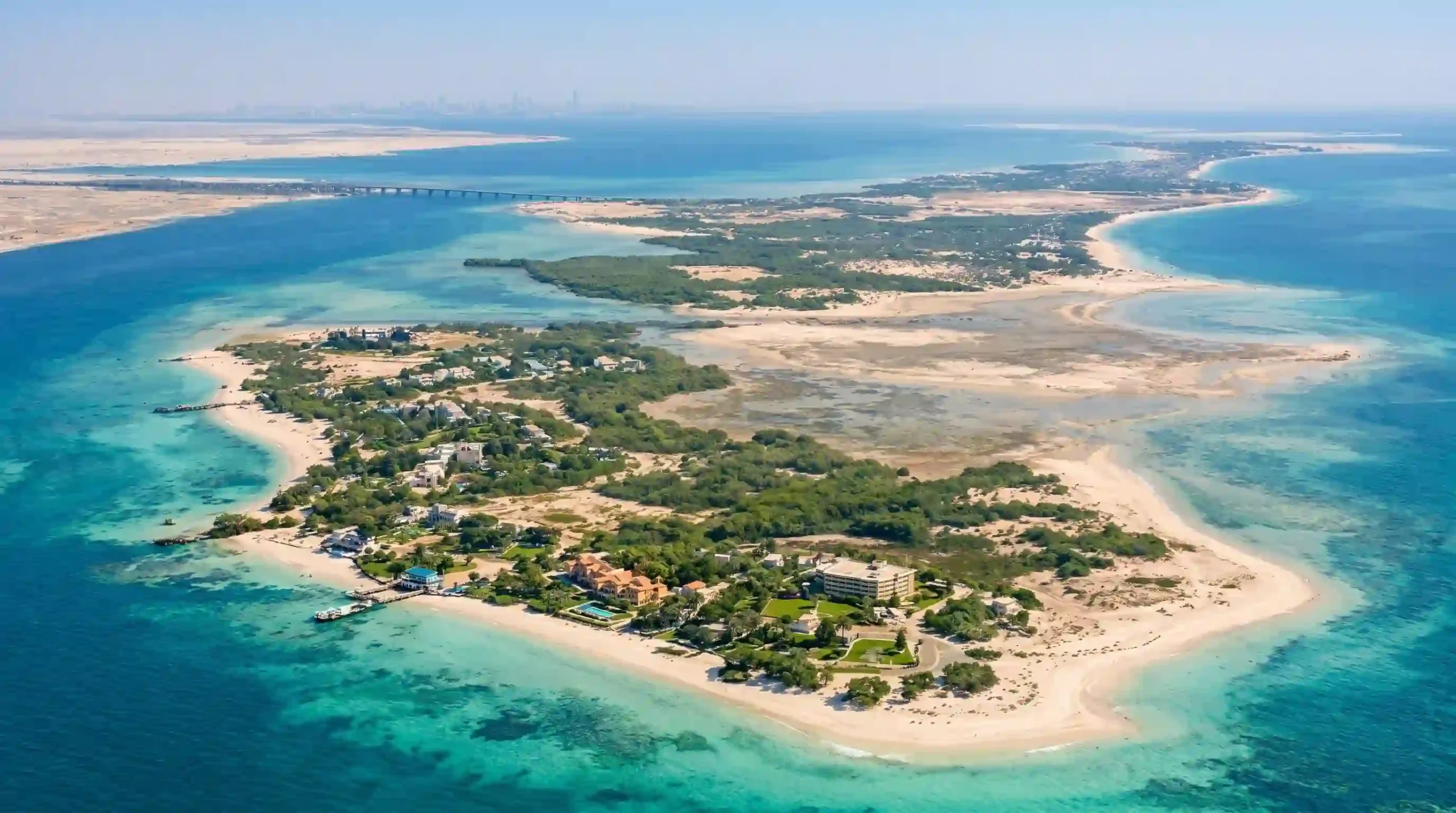
Al Aryam Island sits off the western coast of Abu Dhabi, positioned at the end of the Khor Qirqishan lagoon system in the Persian Gulf. Its geographic coordinates are approximately 24°18’24″N, 54°13’36″E. The island lies around 60 kilometers southwest of central Abu Dhabi city, placing it well beyond the urban buzz while remaining physically connected to the mainland.
Access to the island is made possible through the Al Aryam Bridge Interchange, a major infrastructure project completed in 2019 at a cost of AED 58 million. This bridge connects to a 12.2-kilometer road running along the Sheikh Khalifa bin Zayed International Highway (E11), near the Industrial City of Abu Dhabi (ICAD). From central Abu Dhabi, the drive takes approximately 40 to 60 minutes depending on traffic. There is no public transport route to the island, and access is controlled.
Neighboring islands include Al Dabb’iya Island to the southwest and Al Bahrani Island to the northeast. The surrounding waters are shallow, ranging from 5 to 15 meters in depth, with tidal channels, intertidal flats, and mangrove clusters forming the broader coastal landscape.
For those exploring other parts of the capital, our guide on Abu Dhabi Central Bus Station covers how to get around the city conveniently.
Al Aryam Island: A Quick Overview
Before going deeper, here is a factual snapshot of Al Aryam Island that answers the most common questions at a glance.
| Feature | Details |
| Former Name | Bu Khushaishah |
| Location | Western Abu Dhabi Coast, Persian Gulf |
| Distance from Abu Dhabi City | Approximately 60 km |
| Access Route | Al Aryam Bridge via E11 Highway |
| Bridge Cost | AED 58 million (completed 2019) |
| Ownership | Private (Al Nahyan family) |
| Development Level | Minimal |
| Public Access | Restricted |
| Key Natural Feature | Mangroves, salt flats, white sand beaches |
| Conservation Body | Environment Agency Abu Dhabi (EAD) |
| Best Time to Visit Surrounding Area | October to April |
History of Al Aryam Island
The Pre-Modern Era and Traditional Name
Long before the island was known as Al Aryam, it carried the name Bu Khushaishah. Historical records, including British nautical surveys from the early 19th century, document the island in connection with the pearling trade routes of the Trucial States. The Trucial States were the collection of sheikhdoms along the Arabian Gulf coast that existed under informal British protection before the UAE’s formation in 1971.
The island’s geography, dominated by sabkha plains and lacking reliable freshwater sources, meant it could only support seasonal and transient use rather than permanent settlement. Local communities relied on it for fishing, pearl diving, and coastal grazing activities that were central to Gulf Bedouin life during that era.
After UAE Formation in 1971
Following the establishment of the United Arab Emirates, Al Aryam Island came under the stewardship of the Al Nahyan family, which governs Abu Dhabi. This transition preserved the island’s natural state. While neighboring areas along the coast underwent rapid urbanization and land reclamation, Al Aryam was deliberately excluded from aggressive development plans.
Today, the island’s infrastructure consists mainly of a network of dirt tracks and a single prominent road running northwest to southeast, dividing the island into two halves. Limited construction exists only in the northwest corner, which includes an equestrian center known as the Aryam Stables, owned by Sheikh Hamdan bin Zayed Al Nahyan.
The name Al Aryam reflects post-independence standardization of place names across the emirate, though the earlier Bu Khushaishah reference still appears in older historical documents.
Geography and Physical Features
Al Aryam Island is roughly comparable in size to Abu Dhabi Island itself, making it one of the larger barrier islands in the emirate’s western coastal complex. The terrain is predominantly flat and low-lying, shaped by aeolian and marine processes over thousands of years. Maximum elevation across the island remains below 10 meters.
The geological base of the island consists of Pleistocene unconsolidated quartzose aeolian sands, at least 6 meters thick in places, with marine carbonates layered above. At the island’s northwestern, northeastern, and southwestern edges, outcrops of cemented wind-blown carbonate sands known as aeolianites appear. These remnants date back approximately 125,000 years and were formed during ancient seif dune activity.
The southern shoreline features white carbonate sand beaches formed through successive spits and strand lines deposited by prevailing winds and seasonal marine activity. Tidal channels bound the island on multiple sides, branching into narrower creeks that feed shallow lagoons and intertidal flats. Salt crusts of halite and gypsum form naturally on exposed surfaces due to the region’s intense evaporation.
The island experiences Abu Dhabi’s typical arid desert climate. Summer temperatures reach up to 40°C, and Shamal winds regularly drive sand movement across beaches and sabkha plains. Occasional sandstorms can expose gypsum crystals from the surface sediment layers.

Wildlife and Natural Environment
Mangroves and Coastal Vegetation
One of Al Aryam Island’s most significant natural assets is its mangrove forest. Stands of Avicennia marina, the grey mangrove species native to the Arabian Gulf, thrive in the lower intertidal zones. These mangroves play a critical role in stabilizing shorelines, reducing coastal erosion, filtering water, and providing habitat for marine and bird species. They also absorb significant amounts of carbon, making them important in the context of climate resilience.
In February 2020, Sheikh Hamdan bin Zayed Al Nahyan, Chairman of the Environment Agency Abu Dhabi (EAD), personally participated in a mangrove planting event on Al Aryam Island as part of National Environment Day. This initiative forms part of a larger EAD program targeting the planting of 15 million mangrove seedlings across Abu Dhabi over 25 years, in partnership with entities including Abu Dhabi National Oil Company (ADNOC) and the Department of Municipalities and Transport.
Visitors interested in mangrove ecosystems will find Abu Dhabi’s broader coastal nature scene worth exploring. Our guide to Jubail Mangrove Park Abu Dhabi covers one of the most accessible mangrove parks in the emirate.
Bird Life and Nesting Sites
Al Aryam Island is a recognized birdwatching destination, particularly for migratory and nesting species. The EAD’s 2023 Annual Report identifies Al Aryam as having the third highest number of attended bird nests among all monitored sites across Abu Dhabi. Species include the white-cheeked tern and various waders and seabirds that use the island’s lagoons and mangrove fringes as stopovers during seasonal migrations. EAD actively conducts patrols to prevent poaching and monitors nesting populations as part of the emirate’s broader biodiversity strategy.
Marine Life
The shallow waters surrounding Al Aryam Island support a rich marine ecosystem. Skeletal carbonate sands and some offshore reef structures provide habitat for diverse species. Protected lagoons around the island serve as critical nursery grounds for shrimp (Penaeus spp.) and juvenile fish, where calm, shallow conditions support larval development.
Recreational anglers are drawn to the coastal stretches between Al Aryam and Al Hameem, where tidal movements concentrate fish including queenfish (Scomberoides commersonnianus), barracuda, spangled emperor, mackerel, and hammour (grouper). Fishing in these waters requires a valid recreational fishing license issued by the EAD, with strict catch limits and immediate release requirements for protected species.
Al Aryam Island vs Other Abu Dhabi Islands
Understanding where Al Aryam fits in Abu Dhabi’s island landscape helps clarify why it draws attention despite limited public access.
| Feature | Al Aryam Island | Yas Island | Saadiyat Island | Hudayriyat Island |
| Development Level | Minimal | Fully Developed | Highly Developed | Expanding |
| Public Access | Restricted | Open | Open | Open |
| Tourism Infrastructure | None | Extensive | Extensive | Growing |
| Environmental Focus | Very High | Moderate | Moderate | High |
| Residential Density | Very Low | High | High | Medium |
| Primary Theme | Privacy and Nature | Entertainment | Culture and Luxury | Wellness and Sports |
| Ownership | Private (Al Nahyan) | Mixed / Government | Mixed / Government | Government |
This table illustrates a clear pattern. Al Aryam Island is not competing with Yas or Saadiyat. It occupies an entirely different space in Abu Dhabi’s planning framework, one defined by restraint, ecology, and long-term strategic value.
Who Can Access Al Aryam Island?
This is perhaps the most important practical question, and the honest answer is that general public access is restricted. The island is privately owned and associated with the Al Nahyan family. Security personnel are known to prevent unauthorized entry. There are no tourist entry points, no ticket counters, no hotels, and no commercial facilities on the island.
The Al Aryam Bridge Interchange provides a physical road connection, but access beyond the entry zone requires authorization tied to residency, operational needs, or special permissions.
The surrounding coastal waters, however, offer more flexibility. Recreational fishing in nearby zones is possible with the appropriate EAD license. Kayaking in nearby lagoons and birdwatching from accessible coastal points along the western Abu Dhabi coast can give visitors a glimpse of the island’s natural environment without violating access restrictions.
Organized eco-tours are occasionally arranged by local environmental groups for special events, though these are small in scale and require advance coordination.
Conservation Efforts and Environmental Significance
Al Aryam Island occupies an important position in Abu Dhabi’s conservation framework. The EAD treats the island as a site of ecological significance, conducting regular monitoring of bird populations, marine life, and mangrove health.
The island also falls within the scope of Abu Dhabi’s oil spill monitoring programs, which use aerial surveys and rapid response protocols to protect sensitive coastal habitats from shipping-related pollution in the Gulf. Beach cleanup campaigns targeting plastic debris in the mangroves and along the shoreline are conducted with community involvement.
Motorized vehicle access in fragile coastal zones is restricted to prevent soil erosion and disturbance to nesting sites. This aligns with Abu Dhabi’s commitments under the RAMSAR Convention on Wetlands, an international treaty focused on the conservation and sustainable use of wetland ecosystems.
In 2025, the UAE expanded its network of protected natural areas to 26 sites covering over 22,821 square kilometers, reflecting the country’s growing commitment to ecological preservation. Al Aryam’s restricted, low-footprint character positions it well within this broader framework.
According to the Environment Agency Abu Dhabi’s official website at ead.gov.ae, the emirate’s biodiversity strategy encompasses coastal islands as key components of long-term ecological resilience.
Real Estate and Future Development Potential
Current Status
Al Aryam Island currently hosts a very small number of private estates and grand residences. There are no commercial centers, public housing communities, hotels, or resorts. Urban planners and real estate analysts often classify the island as a strategic reserve rather than an active development zone.
This is not an oversight. It is intentional planning. The island’s value, from a development perspective, lies precisely in what has not been built on it yet.
Long-Term Investment Considerations
As Abu Dhabi’s real estate market continues to mature in 2026, the model of low-density, environmentally sensitive island development is gaining traction across the emirate. Projects like Hudayriyat Island, Bvlgari Island, and the expanding Saadiyat Lagoons community all reflect a shift toward exclusive, nature-integrated living that commands premium pricing.
Al Aryam Island’s limited residential plots, combined with its natural setting and the long-standing pattern of deliberate non-commercialization, suggest that properties here offer the kind of long-term capital growth driven by scarcity rather than speculation.
Ownership on Al Aryam Island is governed under Abu Dhabi’s real estate laws. Historically, island developments of this kind were designed primarily for UAE nationals. However, regulatory frameworks across the emirate continue to evolve, and certain buyers may have access to long-term leaseholds or special permissions as laws develop.
For a broader look at Abu Dhabi’s property landscape and investment opportunities, our Real Estate section covers market updates, community guides, and buyer-focused information.
You can also explore the latest Abu Dhabi island real estate analysis on Hero Real Estate’s 2026 market report for context on how private island developments are being positioned across the capital.
Cultural Significance of Al Aryam Island
Beyond its ecology and geography, Al Aryam holds real cultural weight in the UAE. The island’s historical association with pearl diving, fishing, and coastal Bedouin life makes it a tangible link to the pre-oil era of the Arabian Gulf. For Emirati families, coastal spots like Al Aryam carry a quiet significance tied to ancestral livelihoods and traditions.
The island also hosts the Al Aryam Arabian Horse Show, an event that celebrates Arabian horses as a symbol of Emirati heritage. The Aryam Stables on the island are a reflection of this tradition, with equestrian culture holding deep historical and social importance in UAE society.
On social media, particularly Instagram, Al Aryam has gained visibility as a “hidden gem” of Abu Dhabi, with photographers and travel enthusiasts sharing images of its salt flats, sandy beaches, and undisturbed coastline. Its barren landscapes have also served as backdrops for film and photography productions, drawn by the island’s rare visual character.
Best Time to Visit the Al Aryam Island Area
While public access to the island itself is restricted, those interested in exploring the surrounding coastal area or participating in licensed fishing and birdwatching should plan their visit between October and April. During these months, temperatures range from 20°C to 30°C, making outdoor activity comfortable.
Summer months from June to September bring extreme heat, with temperatures regularly exceeding 40°C, along with higher humidity and Shamal wind activity that reduces visibility and makes coastal conditions challenging.
Frequently Asked Questions
Where exactly is Al Aryam Island located?
Al Aryam Island is located off the western coast of Abu Dhabi, approximately 60 kilometers southwest of the city center. It sits within the Persian Gulf at the edge of the Khor Qirqishan lagoon system and is connected to the mainland via the Al Aryam Bridge along the E11 highway.
Is Al Aryam Island open to tourists?
No. Al Aryam Island is privately owned and access is restricted to authorized individuals. There are no tourist facilities, hotels, or commercial services on the island. Surrounding coastal areas may be visited for licensed fishing or birdwatching with appropriate permits.
What is the former name of Al Aryam Island?
The island was historically known as Bu Khushaishah, a name that appears in early 19th-century British nautical surveys connected to the pearling trade routes of the Trucial Coast.
How do you get to Al Aryam Island?
The island is accessible by road via the Al Aryam Bridge Interchange, a project completed in 2019 costing AED 58 million, connecting to the E11 Sheikh Khalifa bin Zayed International Highway near ICAD. The drive from central Abu Dhabi takes around 40 to 60 minutes. There is no public transport route.
Who owns Al Aryam Island?
Al Aryam Island is privately owned and associated with the Al Nahyan family of Abu Dhabi. Sheikh Hamdan bin Zayed Al Nahyan owns the Aryam Stables located on the island.
Can people buy property on Al Aryam Island?
There is a very limited number of private estates on the island. Property ownership is governed under Abu Dhabi real estate laws and has historically been oriented toward UAE nationals. Regulations continue to evolve and some buyers may qualify for long-term leaseholds.
What wildlife can be found on Al Aryam Island?
The island hosts mangrove forests, nesting sites for birds including the white-cheeked tern, and surrounding waters rich in marine life including queenfish, barracuda, grouper, and marine nursery habitats for shrimp and juvenile fish.
What conservation activities are happening on Al Aryam Island?
The Environment Agency Abu Dhabi (EAD) monitors bird nesting populations, conducts mangrove planting initiatives, and runs oil spill monitoring programs along the island’s coastline. In 2020, Sheikh Hamdan bin Zayed Al Nahyan personally participated in a mangrove planting event on the island.
What is the best time to visit the Al Aryam Island area?
The most comfortable period is October through April, when temperatures range between 20°C and 30°C. Summer months bring extreme heat above 40°C and are not suitable for outdoor coastal activities.
Why has Al Aryam Island not been developed like Yas or Saadiyat?
The deliberate decision to preserve Al Aryam reflects its private ownership, ecological significance, and Abu Dhabi’s strategic approach to long-term land management. The island functions as a natural reserve and strategic asset rather than a short-term commercial development.
Conclusion
Al Aryam Island represents something increasingly rare in a region defined by speed and ambition: a place that has been deliberately left alone. Its salt flats, mangrove forests, white sand beaches, and restricted access make it one of the most distinctive coastal features in Abu Dhabi’s landscape. Historically rooted in pearling and fishing traditions, now protected as an ecological asset, and holding quiet strategic value for Abu Dhabi’s long-term planning, Al Aryam Island occupies a unique position in the UAE’s geography and identity.
While it may not offer the theme parks of Yas Island or the cultural landmarks of Saadiyat, Al Aryam offers something perhaps more valuable in the long run: an honest reflection of what the Arabian Gulf coastline looked like before the modern era, and a glimpse of how Abu Dhabi intends to balance growth with preservation as it moves deeper into this decade.